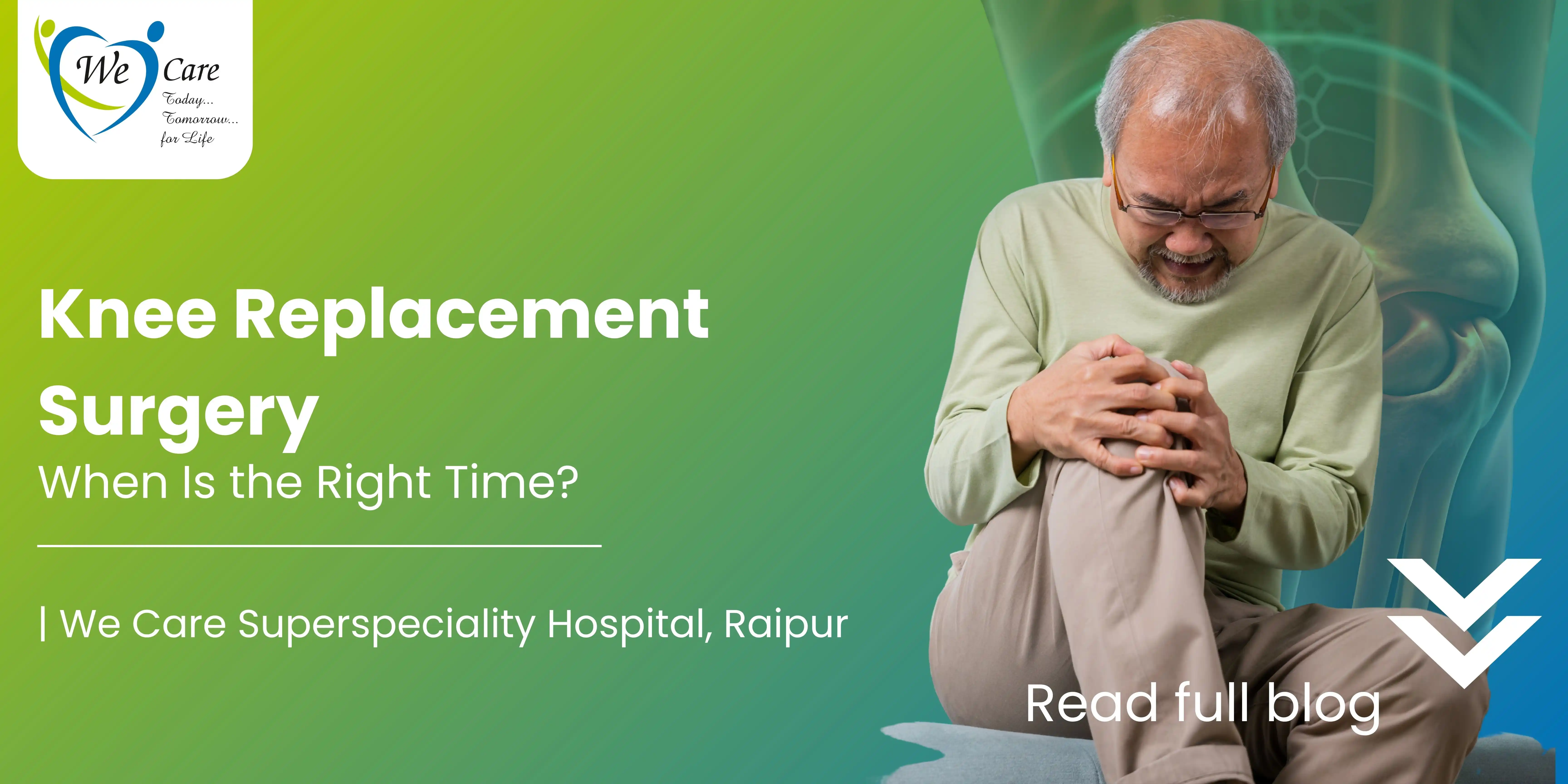
Knee Replacement Surgery in Raipur: When Is the Right Time?
Kamal ji, a 62-year-old retired school principal from Telibandha, Raipur, had been living with knee pain for almost three years. He tried everything — painkillers, hot water bags, oil massages, and multiple rounds of physiotherapy. Every morning, the first few steps out of bed felt like walking on broken glass. His daughter finally convinced him to visit We Care Superspeciality Hospital's orthopedics OPD. Within 20 minutes of examining his X-rays, the answer was clear: he needed a knee replacement — and should have had one a year ago.
Kamal ji's story is not unusual in Raipur. Thousands of people across Chhattisgarh delay knee replacement surgery — out of fear, lack of awareness, or the belief that it's only for the very old or the very rich. In this blog, our senior orthopedic team at We Care answers the question we hear every week in our OPD: "Doctor, kya mujhe surgery ki zaroorat hai?"
What Is Knee Replacement Surgery?
Knee replacement (arthroplasty) is a surgical procedure in which the damaged cartilage and bone surfaces of the knee joint are replaced with artificial implants — typically made of metal alloys and high-grade plastic. It is one of the safest, most successful, and most commonly performed orthopedic surgeries in the world.
There are two main types:
- Total Knee Replacement (TKR) — the entire knee joint surface is replaced. Most common.
- Partial Knee Replacement — only the damaged compartment of the knee is replaced. Suitable for select patients.
Did you know? Over 10 lakh knee replacements are performed in India every year — and Raipur now has the expertise, infrastructure, and implant quality to match any major metro city.
The Most Common Reason: Osteoarthritis (OA)
The overwhelming majority of knee replacements are performed for osteoarthritis — the gradual wearing down of the cartilage that cushions the knee joint. Once cartilage is gone, bone grinds against bone. That is the source of the severe, persistent pain that stops people from climbing stairs, walking to the market, or even sleeping through the night.
Other conditions that may require knee replacement include:
- Rheumatoid arthritis (RA)
- Post-traumatic arthritis (following an accident or injury)
- Severe knee deformity — bowing inward (varus) or outward (valgus)
- Failed previous knee surgery
5 Signs That You May Need Knee Replacement
Not every knee problem requires surgery. But the following signs — especially when they appear together — are strong indicators that it may be time to consult an orthopedic surgeon seriously:
1. Pain That Doesn't Respond to Medicine Anymore
If paracetamol, diclofenac, or even stronger painkillers provide little to no relief — or only a few hours of relief — your joint damage may be too advanced for medication to manage.
2. You've Stopped Doing Things You Love
Avoiding stairs, skipping family functions, refusing evening walks, staying home instead of going to the mandir — when pain starts dictating your life, it's a serious quality-of-life signal.
3. Knee Swelling That Won't Go Away
Persistent swelling — even without injury — indicates active joint inflammation. This swelling is a sign of severe internal damage that rest and tablets cannot fix.
4. Your Knee Looks or Feels Deformed
If your knee is visibly bowing or has shifted out of alignment, the damage is structural. Physiotherapy and braces cannot reverse bone deformity.
5. X-Ray Shows Bone-on-Bone Contact
When your X-ray shows no cartilage space remaining between the femur and tibia — that is bone-on-bone contact. At this stage, no amount of medication, exercise, or injection can restore cartilage. Surgery is the only option that gives lasting relief.
We Care OPD Tip: Bring your knee X-rays (AP and lateral view, weight-bearing if possible) when you visit our orthopedics OPD. A 20-minute consultation can give you a clear answer.
When Is It Too Early — and When Is It Too Late?
One of the most common questions we receive: "Doctor, kya main abhi surgery ke liye young nahi hoon?" or on the other end, "Kya main bahut zyada buddha ho gaya hoon?"
The honest answer: there is no perfect age. The right time for surgery is determined by your pain level, functional limitation, and X-ray findings — not your birthday. However:
- Surgery too early — in a young patient with mild OA — means the implant may wear out before the end of life, requiring revision surgery.
- Surgery too late — like Kamal ji's case — means months or years of unnecessary suffering, muscle weakness, and more complex surgical challenges.
- The sweet spot is when conservative treatment (physiotherapy, weight loss, injections) has been genuinely tried for 3–6 months and has failed to provide adequate relief.
What About Injections? Can They Replace Surgery?
Steroid and hyaluronic acid (gel) injections are useful for mild-to-moderate OA and can provide 3–6 months of relief. At We Care, we often recommend these as a bridge — to help patients manage pain while they prepare for surgery, lose weight, or complete physiotherapy.
Important: Injections do not repair cartilage. They do not slow down OA progression. Repeated steroid injections can actually weaken surrounding tissue. If you have been getting injections every 3 months for over a year, it is likely time for an honest conversation about surgery.
Knee Replacement at We Care, Raipur: What to Expect
Before Surgery
- Full pre-operative evaluation: blood tests, ECG, physician clearance
- Implant selection based on your anatomy, age, and activity level
- Pre-surgical physiotherapy to strengthen the knee — better muscle = faster recovery
- Detailed counselling session with the surgeon
The Surgery
- Duration: 60–90 minutes under spinal or general anaesthesia
- Blood loss is minimal; blood transfusion rarely required
- Precision cuts guided by measurements and templating
Recovery Timeline
- Day 1–2: Physiotherapist helps you stand and take first steps
- Day 3–5: Walking with support, discharged home in most cases
- Week 2–3: Climbing stairs with support
- Week 6: Most daily activities resume
- Month 3–6: Full recovery, return to normal life
"Mujhe lagta tha surgery ke baad main kabhi seedha nahi chal paunga. Lekin 3 hafte mein main apne ghar ki seedhiyan chadh raha tha." — Patient, 67, Raipur (name changed for privacy)
Is Knee Replacement Affordable in Raipur?
Knee replacement costs in Raipur are significantly lower than in cities like Mumbai, Delhi, or Hyderabad — while the quality of implants, theatre equipment, and surgical expertise at We Care is equivalent. Additionally:
- CGHS, ECHS, and most Government health schemes cover knee replacement
- Ayushman Bharat (PMJAY) covers eligible patients
- Most major insurance policies in India cover knee replacement under hospitalisation
- We Care's billing team can help verify your insurance coverage before surgery
We encourage every patient to ask our OPD coordinator about their specific scheme or insurance before assuming it is unaffordable.
Raipur-Specific Considerations
- Many Raipur households have floor-level seating (floor dining, prayer, etc.) — post-surgery, these habits need temporary modification but can be resumed after full recovery.
- The pre-monsoon and early monsoon period (May–July) is actually a good time for elective knee replacement — recovery happens during the rainy season when outdoor activity is naturally limited.
- Patients from Durg, Bilaspur, Korba, and surrounding districts can access We Care's orthopedics OPD without traveling to Nagpur or Hyderabad.
The Bottom Line
Knee replacement is not a surgery of last resort. It is a quality-of-life procedure — one that gives people back their independence, mobility, and dignity. Thousands of patients at We Care have walked out of our hospital pain-free after years of suffering.
If you have knee pain that is limiting your life — and you have been managing it for months without lasting relief — the next step is a proper evaluation, not another painkiller.
We Care Superspeciality Hospital – Raipur
Because We Care – Today, Tomorrow, and for Life.
Know Our Specialists
OR
Reach Us Out: